What Financial Documents Are Important for Self-Employed Loan Applicants? Complete Checklist
If you run a business, work as a freelancer, or earn independently, applying for a loan may require a different set of documents than a salaried applicant. Lenders generally review your income, business activity, bank transactions, and financial stability before assessing an application. Understanding which records to prepare can make the process more organised.
Which financial documents should you prepare?
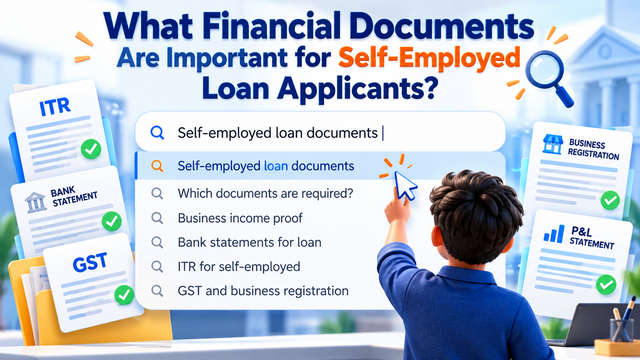
Self-employed applicants are commonly asked for bank statements, Income Tax Returns (ITR), business registration or proof of activity, financial statements, and identity and address documents. The exact requirements depend on the lender, loan amount, business type, and applicant's financial profile.
Important Financial Documents for Self-Employed Applicants
Different records help lenders understand different aspects of your financial position. Keep the following documents organised before starting an application.
Income Tax Returns (ITR)
Recent ITR acknowledgements and computation of income can help demonstrate declared earnings and financial history. Lenders may request one or more financial years.
Bank Statements
Statements generally covering the last 6–12 months may be requested to review business receipts, expenses, balances, and transaction patterns.
Registration Documents
Depending on your business structure, this may include GST registration, Udyam registration, Shop and Establishment certificate, or other valid business proof.
Profit & Loss Statement
A profit and loss statement can show revenue, operating expenses, and business profitability for a particular period.
Balance Sheet
Where applicable, this provides an overview of business assets, liabilities, and financial position.
GST Returns
For GST-registered businesses, relevant returns may help support reported turnover and business activity.
PAN & Aadhaar
These may be required for identity verification, KYC checks, and financial documentation.
Invoices & Business Records
Sales invoices, purchase records, client contracts, and payment receipts can help establish the nature and continuity of your work.
How Do Lenders Assess Self-Employed Income?
Unlike a fixed monthly salary, independent earnings can change from month to month. Lenders may therefore examine multiple records instead of relying on a single document.
Key areas they may review
- Annual income: Earnings declared in your financial records.
- Business turnover: The volume of business activity reflected in relevant records.
- Net profitability: Income remaining after eligible business expenses.
- Cash flow: Regularity of money coming into and going out of your account.
- Existing obligations: Current EMIs, loans, and other repayment commitments.
- Credit history: Previous repayment behaviour and outstanding credit.
Remember that business turnover and personal income are not necessarily the same. A lender may assess net income and repayment capacity according to its own credit policy.
Why Are Bank Statements Important?
Bank statements provide a transaction-level view of your finances. They can help a lender understand whether business receipts are regular, how expenses are managed, and whether existing repayments are being handled.
Before submitting statements, check that:
- You have downloaded the complete statement for the requested period.
- Your account details and transaction entries are clearly visible.
- Business-related credits can be explained if clarification is requested.
- There are no missing pages or altered entries.
- Any unusual transactions can be supported with relevant records.
Interactive Self-Employed Document Checker
Select your work category to see a practical preparation list. Actual lender requirements may differ.
Common Documentation Mistakes to Avoid
Incomplete or inconsistent records can lead to additional queries and processing delays. Review your documents before submitting them.
Missing financial years
Check whether the lender needs one, two, or more years of ITR records.
Unexplained transactions
Keep supporting details for large or unusual credits when available.
Different business details
Make sure names, addresses, and business information are consistent across records.
Incomplete statements
Submit the full statement rather than selected screenshots or partial pages.
How LoanSathi Assists Self-Employed Applicants
LoanSathi.in is a loan assistance platform that helps applicants explore financing options through a network of 150+ banks and NBFCs. We do not directly lend money or guarantee approval.
The process starts with slot booking. Our team then collects and reviews your documents to understand your profile and identify lenders whose criteria may align with it. Available offers, including the lender name, eligible amount, interest rate, and tenure, are shared with you. An application is submitted to the selected lender only after you confirm the offer. The lender independently assesses the application and makes the final decision on disbursement.
For more details, visit our banking and NBFC network or explore our loan products.
Explore Loan Options
Explore the relevant loan category to understand the available assistance and general requirements.
Frequently Asked Questions
Can I apply for a loan without GST registration?
Some lenders may consider applicants who are not GST-registered, depending on their business type, income proof, and internal policies. Other supporting documents may be requested.
Is ITR compulsory for every self-employed applicant?
Not necessarily. Requirements vary by lender and loan product. Some may consider alternative income or business records, while others may require ITR documents.
How many months of bank statements are needed?
Many lenders request 6–12 months, but the exact period depends on the product and applicant profile.
Does submitting all documents guarantee loan approval?
No. Complete documentation supports assessment, but approval depends on the lender's eligibility criteria, credit checks, repayment capacity, and verification.
Can LoanSathi help me explore multiple lenders?
LoanSathi assists applicants in exploring options through its network of 150+ banks and NBFCs. Final eligibility and approval remain with the respective lender.
Prepare Your Documents Before Applying
Organising your financial records in advance can make the loan application process clearer and help reduce avoidable documentation queries.
Explore your options at LoanSathi.in or download the app.


Disclaimer: This article is for general informational purposes only. Document requirements, eligibility, interest rates, and loan terms vary by lender and applicant profile. LoanSathi is a loan assistance platform, not a bank or direct lender. The respective lender makes the final credit decision.
↑ Back to Top